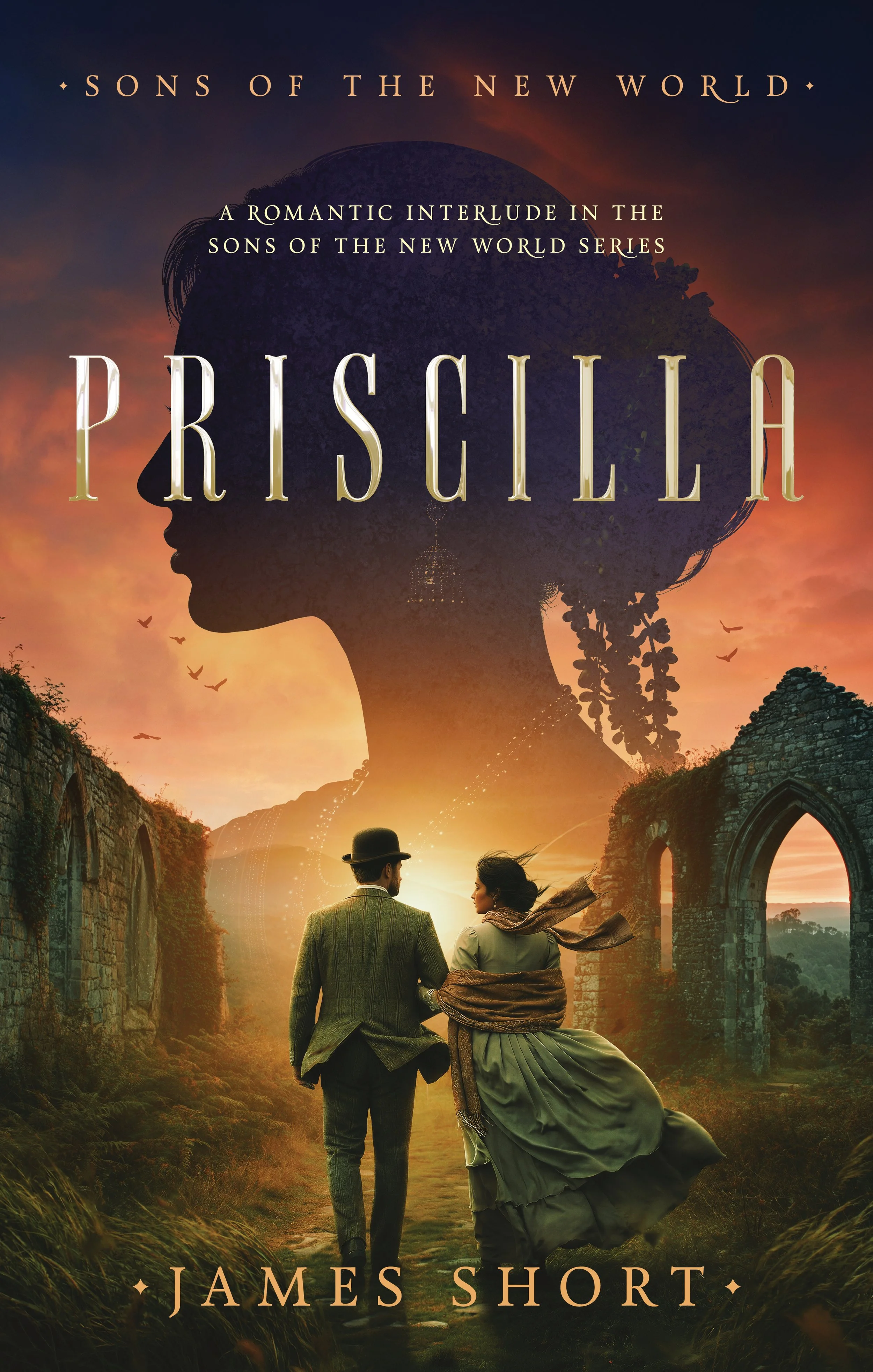
Priscilla is in the way. She doesn’t belong in the London Season.
Priscilla isn’t a debutante. She had come at the behest of Dahlia, a well-off friend. Dahlia found a suitor at the first party and is now ignoring her.
Priscilla might have fit in. Modest, well-spoken, as beautiful as a heroine in an Arabian Nights fable, but her dowry is too small and her skin too dark.
So, her days pass uneventfully until, on a walk in Hyde Park, she comes across a little boy who is crying because the mast of his toy boat has broken. From her tomboyish childhood, she has experience in fixing toy boats.
As a result of that simple act of kindness, Priscilla will be swept into a world of unrequited love, unexpected passion, and terror.
Priscilla falls in love with Charles, the boy’s guardian. His fiancée, Emilia, is a beauty with a sharp tongue and a dreadful secret.
Emilia’s brother, Francis, is mad. He amuses himself by taking on different identities and is bankrupting her family.
Charles falls in love with Priscilla without falling out of love with Emilia. However, he would die rather than go back on a promise.
Priscilla’s story unfolds in the polite society of London, among the ruins half-forgotten in the English countryside, and in an isolated village whose inhabitants never stopped speaking the Old English of Anglo-Saxon times. It comes to a head on a terrible night at Emilia’s manor house, when evil is let loose in the passageways and the grounds, and a life-or-death decision must be made.
Priscilla’s dowry is too small, and her skin is too dark to fit into society. A simple act of kindness sweeps her into a world of passion and unrequited love. The story unfolds in London’s society and the ruins and villages of the English countryside. It comes to a head on a terrible night at a manor house, when evil is let loose in the grounds.
📖📖📖📖📖📖📖📖📖📖📖📖📖📖📖📖📖📖📖📖📖📖📖📖📖📖📖📖📖📖📖📖📖
REVIEW OF PRISCILLA
"Priscilla offers a gripping and refreshingly subversive take on a society rigidly bound by convention.
At its center is Priscilla, a heroine whose gypsy heritage and darker complexion set her apart in a world preoccupied with lineage and appearances. Though her position within society appears predetermined, her modest dowry and lack of prestigious ancestry render her an outsider, subtly exposing the hypocrisy of social hierarchies.
The narrative gains momentum as the Season unfolds—a backdrop ripe with expectation, alliances, and quiet betrayals. Even lifelong friendships, such as that with Dahlia, prove fragile under the weight of ambition and social pressure. Priscilla’s chance encounter with Charles, who is already engaged to the highly sought-after Emilia, ignites a series of events that challenge both personal loyalties and societal norms. What follows is not merely a romantic entanglement, but a deeper exploration of love’s defiance against rigid expectations.
Yet the novel does not rest solely on romance. A darker thread emerges as Priscilla finds herself in peril, uncovering a troubling pattern of secrecy, violence, and disappearances. These elements lend the story an undercurrent of tension, elevating it beyond a conventional period drama.
Ultimately, Priscilla is a story of courage and moral conviction. Its richly drawn characters and layered conflicts invite readers to question tradition and champion authenticity. Though set in the 19th century, its themes resonate strongly with contemporary audiences, making it both an engaging and thought-provoking read that lingers well beyond its final pages," The International Review of Books.
Quisque iaculis facilisis lacinia. Mauris euismod pellentesque tellus sit amet mollis.